

Diverging Forecasts: What Australia’s 2026 Housing Outlook Means for Buyers
Australia’s two big banks agree that national home prices should still rise next year (around 5% in 2026 and slowing to ~3% in 2027), despite last year’s strong 8.6% jump. Higher interest rates and tighter credit are expected to cool demand, while a slight dip in population growth will also ease pressure on prices. Notably, neither bank predicts any capital city will see outright falls.
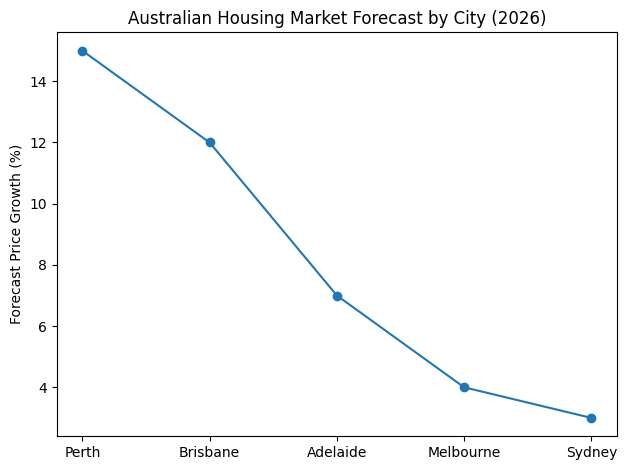
Nationally, prices are expected to grow around 5% in 2026 before slowing to roughly 3% by the end of 2027. Even the softer markets aren’t looking at any kind of collapse; Sydney and Melbourne are more likely to flatten out or tick up modestly rather than fall away. On the investor side, proposed cuts to the capital gains tax discount, potentially dropping from 50% down to around 25%, could put some people off buying. And underneath all of it, the same problem that’s been driving prices for years is still very much there, not enough homes in the places people actually want to live.
City-by-City Outlook For Better Understanding
Brisbane & Perth: These mid-sized capitals have been standouts. Both cities put up double-digit price gains through 2025, and forecasters don’t see that slowing down anytime soon. Commonwealth Bank is calling for around 12% growth for Brisbane and roughly 15% for Perth heading into 2026.
Sydney & Melbourne: The two biggest markets look relatively steady. Sydney’s prices are expected to eke out only small gains (~2-3%) next year, because affordability is a major headwind. (Buyers there may find that even a 5% deposit scheme doesn’t stretch far in pricey suburbs.) Melbourne’s outlook is a bit brighter. After years of slower growth, improving affordability, and the end of population outflows, a catch-up is possible. Westpac sees about 4% growth in 2026, picking up to ~6% in 2027, as the city “has more headroom for medium-term gains”.
Crucial Advice for Buyers That Cannot be Ignored
As buyer’s agents, we see both opportunity and caution in these forecasts. On one hand, a slowing market means less frantic competition. On the other hand, supply remains tight in the most liveable suburbs, so good properties will still command strong prices. Here’s what Australian buyers should keep in mind:
- Focus on fundamentals: Target areas with strong demand and limited new stock – for example, neighbourhoods well-serviced by transport and jobs. Even if overall growth slows, these pockets tend to outperform.
- Use support schemes: If you’re a first-home buyer, take advantage of the government’s 5% deposit guarantee scheme. It’s helping many people get in with lower deposits (and no LMI).
- Plan for higher costs: Rates are higher than they were in 2023, so knowing exactly what you can borrow and what you can comfortably spend before you start bidding is more important than ever. Affordability is going to feel tighter, particularly in Sydney and inner Melbourne.
- Consider tax changes: Proposed CGT reforms could land in the 2026 Budget and cool things down on the investor side a bit. That might take some competition out of the market, but it’s also worth factoring into your long-term thinking before you commit.
- Choose suburbs wisely: Not every suburb is moving in the same direction right now, and picking the right one matters more than it used to. Growth corridors and areas where supply has consistently struggled to keep up tend to hold their value better over time.
Ready to make your move? For tailored advice on which markets and suburbs suit your goals, contact Investmate. We guide buyers through changing conditions. Call us on +61 421 942 049 or book a free consultation today. Follow us on Instagram and LinkedIn for more insights.