

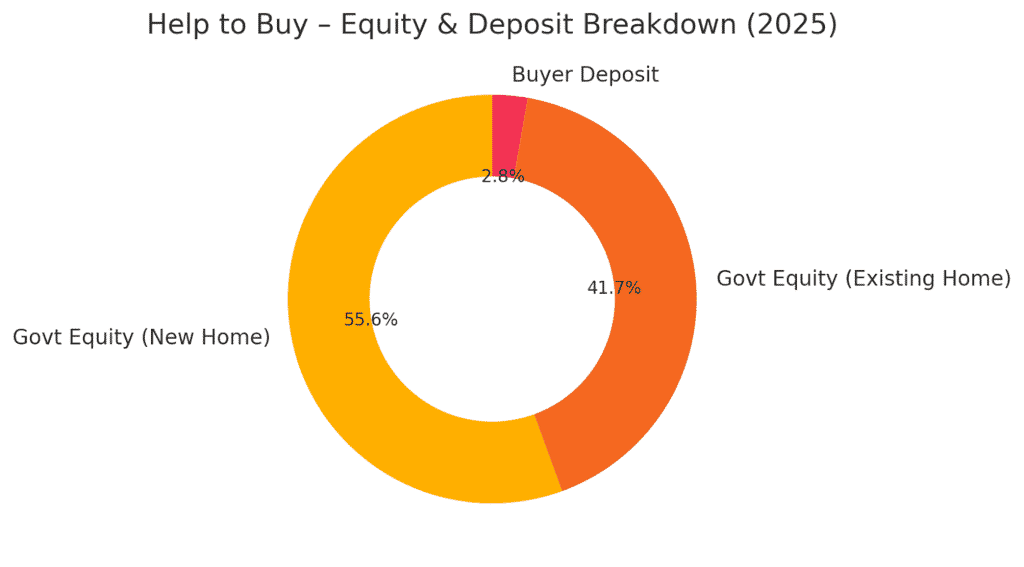
The Australian government’s Help to Buy shared-equity program starts on 5 December, making it much easier for first-home buyers to enter the market. It will assist up to 40,000 households to buy a new or existing home with a government equity contribution. Eligible buyers now need only a 2% deposit (with no lenders’ mortgage insurance). The Commonwealth will take up to a 40% equity stake in new builds and 30% in established homes, meaning buyers co-own with the government until they pay out that share. Income caps (around $100k single, $160k joint) and property price caps apply (e.g. up to $1.3m in Sydney, $1.0m in Brisbane).
Surge in first-home buyer activity
With entry barriers so low, many first-home buyers are expected to act quickly. The Housing Industry Association (HIA) notes that schemes like this “are effective in getting people into their own home and new housing supply is stimulated”. In practice, this means a wave of buyers chasing properties – especially detached houses – in key locations. Many first-timers want standalone homes for space and value, so we anticipate strong demand in outer and growth areas where house prices meet the scheme’s limits. Competition for established houses could intensify as a result.
Homes and suburbs in focus
Nationwide, detached houses already carry a significant premium over apartments. Recent data show the median house in major cities is about $1.09 million versus $728,000 for a unit (roughly a $363,000 gap). Help to Buy is likely to push that gap further as buyers target land-rich suburbs. Buyers and agents will need to watch the price caps carefully – some inner-city suburbs may exceed the limit, steering demand to outer or regional centres. New and off-the-plan developments could also pick up steam, since the government’s share is higher for new builds (40% versus 30%).
Impact on investors and market balance
Help to Buy is only for owner-occupiers (not investors), so local buyers will be more active. This changes the game for investors: many may pivot to apartments or other markets where competition is lower. In the short term, extra demand could lift house prices faster, given the tight supply. Industry data show houses have been outperforming units recently, and a flood of first-home buyers is likely to reinforce that trend.
Prepare to act and get guidance
Entering Help to Buy requires planning. Only certain lenders – initially, the Bank of Australia and the Commonwealth Bank – are signed up for Help to Buy loans, so buyers will need to move quickly to secure finance. Working with a buyer’s agent can make a difference. At Investmate, we closely track such schemes and market trends, helping clients find the right suburbs and meet deadlines.Ready to make your move? For tailored advice on how Help to Buy affects your buying strategy, contact Investmate Buyers Agency. Call us at +61 421 942 049 or book a free consultation today. Investmate is here to guide you and secure the right property in this changing market.
